


In the heart of Milan, just behind the Marchesi 1824 pastry shop on Corso Magenta are the ruins of the Roman Imperial Palace in Milan where Emperor Maximianus resided in 286 A.D.
In this article

——— Continue for free ———
Thank you for reading MilanoStyle. This article is a free sample of our Subscriber content featured in MilanoStyle Magazine. Subscribing to a paid MilanoStyle membership helps support the work we do and gives you access to all digital issues of the magazine and the print editions during your subscription period. If now is not the right time to subscribe, no worries. You can still enjoy the free newsletter, plenty of free articles, travel ideas and insider tips about Milan and Italy on MilanoStyle.com.
——— Continue reading ———
Milan is often associated with fashion, finance, design, and fast-paced modern life, but beneath its elegant streets lies a much older story. Long before the city became Italy’s capital of style, Milan was an important Roman center with imperial significance.
What many visitors do not realize is that traces of Roman Milan still survive, quietly woven into the fabric of the contemporary city. You do not need much imagination to find them. In a few corners of Milan, ancient columns, palace remains, and fragments of city walls still stand as reminders of a time when emperors ruled from here.
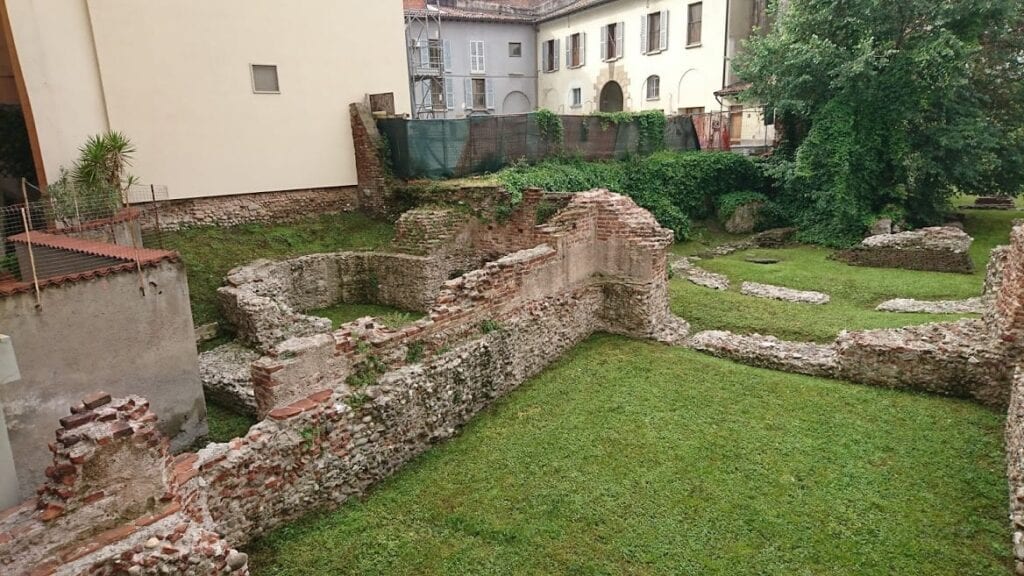
Once a vast property with a palace, imperial baths and chariot racing grounds, today the ruins are preserved in this central neighborhood of Milan.
Mediolanum
Long before Milan became the sleek capital of fashion and finance, it was known to the Romans as Mediolanum, a name already in use when the city was conquered in 222 B.C. At that time, it was a major settlement of the Insubres, a Celtic people of northern Italy, before being absorbed into the growing Roman Empire. Rome’s movement north was not accidental. The Romans were expanding into Cisalpine Gaul to secure trade routes, strengthen military control, and consolidate their hold over the fertile lands on the southern side of the Alps. In doing so, they recognized the strategic value of Mediolanum, ideally placed between the Po Valley and the Alpine passes, making it one of the most important cities of the region.
When Milan Was an Imperial City
The Roman origins of Milan are more important than many people think. In the late Roman period, the city was not merely a provincial outpost. It became a seat of power.
In 286 A.D., Emperor Maximianus chose Milan as the seat of his empire and made it one of the most important cities of the Western Roman world. This decision elevated Milan politically and strategically, placing it at the center of the Roman sovereign. What followed was the development of a grand imperial complex that included a palace, baths, and ceremonial spaces suited to the needs of an emperor and his court.
Today, only fragments remain, but they offer fascinating glimpses into the scale and prestige of Roman Milan.
The city’s Roman past has surfaced repeatedly during modern metro construction. Most notably, works for the M4 Blue Line uncovered a Roman necropolis with numerous burials and artifacts in the Sant’Ambrogio area.
More broadly, the M4 archaeology map ties the line’s central construction areas to several parts of ancient Mediolanum, including late Roman walls, baths, the forum, the theatre, the imperial palace, the Roman Porta Ticinensis, and the amphitheatre area.
Stations to see Roman ruins in Milan are: Duomo (M1) with ancient pavements and roads; Missori (M3) showcasing imperial walls and columns; Sant’Ambrogio (M2-M4) featuring a museum tunnel of medieval walls; and De Amicis (M4) displaying a Roman wall and necropolis remains.
The Roman Imperial Palace


One of the most evocative places to discover Milan’s Roman past is in the heart of the city, just behind the elegant Marchesi 1824 pastry shop, just off Corso Magenta on Via Santa Maria della Porta and Via Brisa.
Here, somewhat hidden within a central neighborhood better known for refined shops and beautiful historic buildings, are the ruins of the Roman Imperial Palace of Milan, where Emperor Maximianus resided. It is extraordinary to think that in this very area stood a vast imperial property that once included not only the palace itself, but also imperial baths and chariot racing grounds.
The remains visible today are modest compared to the scale of the original complex, yet they are deeply evocative. They invite visitors to imagine a Milan that was once one of the great political centers of the Roman Empire. For visitors interested in layers of history, this site is especially rewarding because it reveals how Milan’s ancient past sits almost casually beside its polished modern identity.
The Archaeological Museum of Milan
To better understand the Roman origins of the city, a visit to the Milan Archaeological Museum located at Corso Magenta 15, is essential.
The museum preserves artifacts documenting Roman Milan, along with sections of the ancient imperial walls, mosaic pavements and statues. These remains help reconstruct the story of Mediolanum, the Roman city that preceded modern Milan.
Seeing the walls in person gives a much stronger sense of Milan as a fortified and important urban center, rather than simply a city that later rose to prominence.
The museum adds context to the palace ruins on Corso Magenta, allowing visitors to piece together a broader picture of imperial Milan and the role it played in late antiquity.
During his reign, Emperor Maximianus made Milan the seat of his empire. Many other artifacts, as well as sections of the imperial wall, are preserved in the Milan Archaeological Museum.
The Columns of San Lorenzo
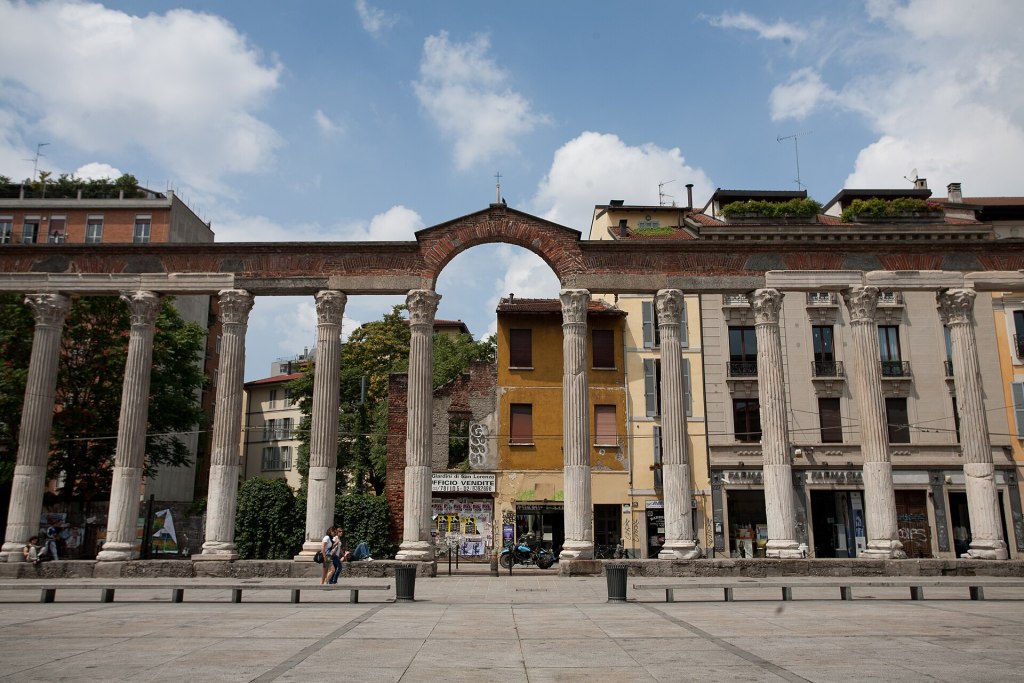
Another striking monument of Roman rule can be found on Corso di Porta Ticinese, in the area known as San Lorenzo. The colonnade in front of the basilica is one of Milan’s most recognizable ancient sights. Some of the columns that once held the vaulted ceiling of the imperial baths (on Via Brisa) are now found here, creating a dramatic and unmistakably Roman presence in one of the city’s liveliest districts.
The contrast is part of their charm. Today, the Columns of San Lorenzo are surrounded by students, locals, nightlife, and the everyday rhythm of Milanese life. Yet these ancient stones connect present-day Milan with its imperial past in a direct and tangible way.
These are only some of the ancient remains. Surely there are other relics of Mediolanum beneath our feet.
History Walks and Tours in Milan
Explore the ancient history of the city with expert context, Milan also has a good selection of guided history walks and cultural tours on GetYourGuide. Current options include general historic walking tours through the city center, private tours focused on Milan’s major landmarks and architecture, and longer experiences that combine a historical walk with entry to Leonardo da Vinci’s Last Supper. Some itineraries highlight the Duomo, Galleria Vittorio Emanuele II, Piazza della Scala, Castello Sforzesco, and Santa Maria delle Grazie, while others take a more specialized approach, such as evening history walks or tours centered on Milan’s historic churches. For visitors who prefer structure and storytelling rather than exploring independently, these tours can be a useful way to connect Roman, medieval, Renaissance, and modern Milan into one coherent narrati
Do you love history? Find historical tours of Milan
Photos by C. Abernethy
Also nearby: Marchesi 1824 pastry shop
Discover more from MilanoStyle.com
Subscribe to get the latest posts sent to your email.