
Traditional Chinese gateways mark Chinatown districts from London to Los Angeles. The proposal for a monumental entrance on Via Paolo Sarpi, however, has met strong opposition from residents and established businesses concerned about overcrowding, tourism and the neighborhood's identity.
Milan Chinatown could soon have a new architectural landmark, but the people who live and work there are far from convinced that it is a good idea.
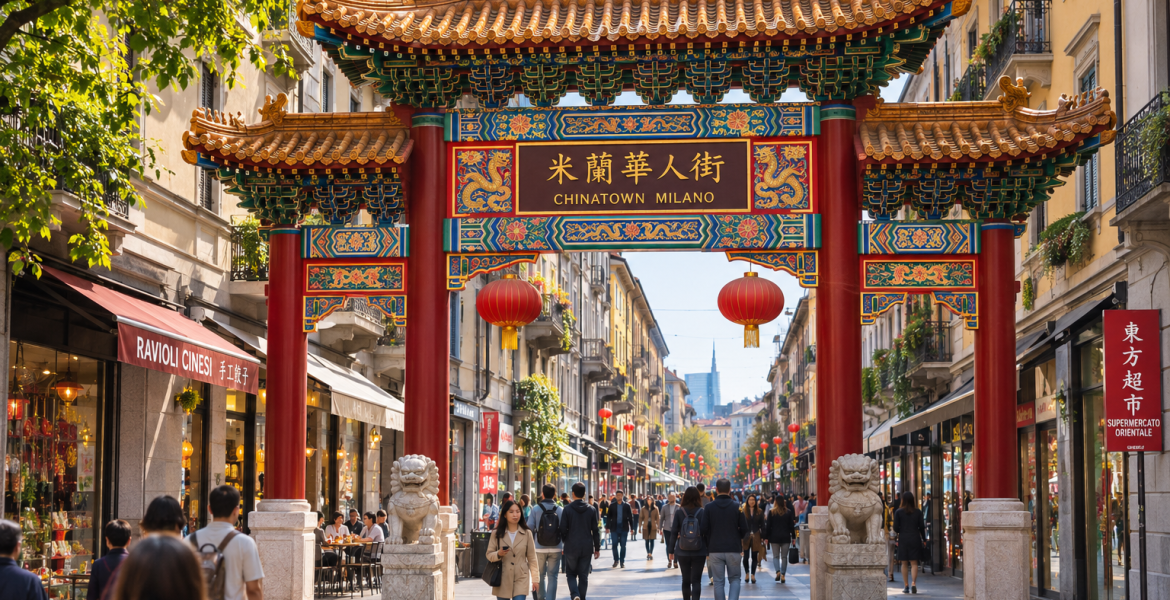
Featured image: AI-generated illustration of a possible traditional Paifang in Milan Chinatown; this is not an official design or an approved proposal.
The City of Milan has proposed installing a Paifang, a traditional Chinese ceremonial gateway, at the entrance to Via Paolo Sarpi near Piazzale Baiamonti. Intended to celebrate the Chinese community's contribution to Milan and strengthen the neighborhood's cultural identity, the project has instead sparked a debate about overtourism, urban planning and the changing character of one of the most distinctive districts in Milan.
According to newspaper la Repubblica, reporting on November 6, 2026, a petition organized by the neighborhood association ViviSarpi collected 1,386 responses from residents. Of those, 1,204 opposed the project and 182 supported it, meaning approximately 87% of residents who participated in the consultation were against the proposed gateway.
The signatures are to be presented to the municipal administration, together with a request for greater public consultation.
A Tradition Found in Chinatowns Around the World
Traditional Chinese gateways are familiar landmarks in international cities. London has several elaborate entrances to its Chinatown, including the imposing gateway on Wardour Street. Los Angeles has its historic Chinatown gates, while the Dragon Gate in San Francisco has become one of the neighborhood's most recognizable symbols.
Similar architectural landmarks can be found in Philadelphia, with its Friendship Gate, and Sydney, where ceremonial gateways have stood on Dixon Street since 1980.
These structures serve both symbolic and practical purposes. They celebrate Chinese heritage, create recognizable entrances to cultural districts and frequently become popular tourist attractions.
The proposed gateway in Milan would follow this international tradition, although the local Chinatown has developed its own distinctive character over the past century.
A Neighborhood That Grew Naturally
Long before the Chinese community settled here, the area was known as Borgo degli Ortolani, a district of market gardeners beyond the old city walls. As Milan expanded, the gardens gradually gave way to workshops, residential courtyards and small commercial businesses.
The first Chinese immigrants arrived during the 1920s and 1930s, many from Zhejiang province in China. They established small businesses producing silk ties, leather accessories and clothing, drawing on the manufacturing traditions of Milan and the silk industry of nearby Como.

Over the decades, the community grew alongside the existing Italian population. By the late twentieth century, the neighborhood had become an important center for Chinese wholesale businesses, although the rapid commercial expansion also created tensions over traffic, deliveries and residential space.
The pedestrianization of Via Paolo Sarpi in 2011 helped transform the area once again. Today, wholesale operations have largely given way to restaurants, specialty food shops and independent businesses.
Chinese supermarkets and dumpling shops share the streets with longstanding Milanese establishments, including Cantine Isola and other historic neighborhood stores.
What makes Via Paolo Sarpi interesting is precisely this mixture. It is not a purpose-built Chinatown designed for visitors, but a neighborhood that evolved naturally through generations of immigration, entrepreneurship and cultural exchange.
Why Residents and Some Business Owners Are Opposed
The principal concern is not necessarily the celebration of Chinese culture, but the potential consequences of attracting even more visitors to an already crowded neighborhood.
Via Paolo Sarpi has become one of the most popular destinations in Milan for Asian street food, particularly on weekends. While the transformation has benefited many businesses, residents have increasingly raised concerns about litter, noise and the pressures of nightlife.

The opposition is being coordinated by ViviSarpi, an independent, nonpartisan residents' association whose origins date to 1999. The organization was formed to address changes in the Sarpi-Bramante-Canonica area and has long advocated for residential quality of life, preservation of the neighborhood's character and balanced integration between communities.
The petition was organized in collaboration with SarpiDOC, an association representing many historic local businesses. Signatures were collected directly from residents, building by building, rather than through an online survey.
Interestingly, some established business owners are also questioning the proposal, even though a new landmark could potentially attract more customers.
According to la Repubblica, several longstanding businesses, including the well-known wine shop Cantine Isola, have expressed opposition to the gateway.
Luca Sarais, owner of Cantine Isola and a neighborhood resident, told Corriere della Sera in October that importing a gateway model from abroad was anachronistic, arguing that the distinctive quality of Via Paolo Sarpi lies in its cultural mixture.
Speaking to Corriere della Sera, longtime resident Tina Fasano, aged 96, also questioned the proposal, arguing that the monumental entrance would be intrusive on an already narrow street and would fail to reflect its diverse population.
Giuseppe Fasola, a member of the ViviSarpi committee, told the same newspaper that residents should have been consulted before the municipality advanced the proposal.
In its statement reported by la Repubblica, ViviSarpi warned that a monumental gateway could further transform the neighborhood into a “quartiere Luna Park”, effectively a tourist amusement park rather than a residential community.
The association highlighted the substantial visitor numbers and waste already generated on busy weekends, with reports of approximately six tons of garbage over two days.
There is also concern about cultural representation. A monumental gateway could visually define the area as an exclusively Chinese district when its history and population are considerably more diverse.
An entrance also establishes a boundary, distinguishing what lies inside from what lies outside. In a neighborhood that has developed through the integration of different communities, such a distinction could arguably create a symbolic separation where none is needed.
For opponents, the issue is therefore as much about preserving the neighborhood's authenticity and participation in local decisions as it is about architecture.
A Symbol of Pride for the Chinese Community
Not everyone agrees with the opposition.
Supporters regard the Paifang as a long-overdue recognition of the Chinese community's economic, cultural and social contribution to Milan.
Stephane Hu, honorary president of the Italy-China entrepreneurs' association UNIIC, told Corriere della Sera that he supports a gateway that would communicate the history of the Chinese community and reflect the international reputation of Milan for design.
He advocated a contemporary interpretation rather than simply reproducing traditional architecture.
Other supporters see the gateway as a welcoming symbol that could strengthen the district's appeal without diminishing its multicultural identity.
The proposal itself is not new. According to Corriere della Sera, local business owners first suggested a gateway ahead of Expo Milano 2015, but the idea was abandoned amid concerns about costs and opposition from residents.
There is certainly a place for celebrating the Chinese community and its contributions to Milan. The question is whether a monumental gateway is the most appropriate way to do so.
What Happens Next?
The municipal government approved the initial guidelines for the project on July 30, 2026, presenting the gateway as part of its broader program of urban regeneration and cultural recognition.
The public call for proposals, covering the design, financing and construction of the Paifang, was launched in August. The original submission deadline of November 16 has since been extended to December 16, 2026.
Importantly, the municipal notice confirms that accepting proposals does not oblige the city to approve or construct a gateway.
Meanwhile, on October 27, the Council of Municipio 1 unanimously approved a motion requesting a participatory consultation involving residents, businesses and neighborhood associations before a final decision is made.
The question now is whether Milan will proceed with the monumental entrance or reconsider the proposal in response to local opposition.
For a city that celebrates design, architecture and multiculturalism, the discussion raises an interesting question: Should a neighborhood's identity be defined by a new landmark, or by the people and businesses that have shaped it over generations?
Overtourism is already changing the character of neighborhoods in many European cities. The challenge is not simply attracting visitors, but preserving the everyday life, independent businesses and cultural authenticity that made these places interesting in the first place.
Via Paolo Sarpi already has an unmistakable personality. Its appeal lies in the natural coexistence of cultures, shops and residents, not in a carefully constructed tourist identity.
Perhaps the most meaningful way to celebrate Chinatown is to protect the qualities that make it worth visiting.
Resources & Further Reading
- la Repubblica, Zita Dazzi, November 6, 2026. Portale cinese in via Paolo Sarpi, contrario l'87% dei residenti – Reporting on the ViviSarpi petition, business opposition and concerns about tourism.
- Comune di Milano, July 30, 2026. Municipal Announcement Approving the Guidelines for the Paifang – Official explanation of the proposal.
- Comune di Milano, updated October 29, 2026. Official Public Notice and Extended Project Deadline.
- Corriere della Sera, Elisabetta Andreis and Chiara Evangelista, October 8, 2026. Milano e il Paifang della discordia – Interviews with residents and local business owners.
- Corriere della Sera, Elisabetta Andreis, October 10, 2026. The Debate Among Supporters and Opponents of the Gateway.
- ViviSarpi, About the Association – History, objectives and involvement in neighborhood affairs.
- VisitMilano, Chinatown: A Kilometer of China in Milan – Historical background and neighborhood development.
Discover more from MilanoStyle.com
Subscribe to get the latest posts sent to your email.