

Sometimes the smallest architectural details lead to the most interesting discoveries.
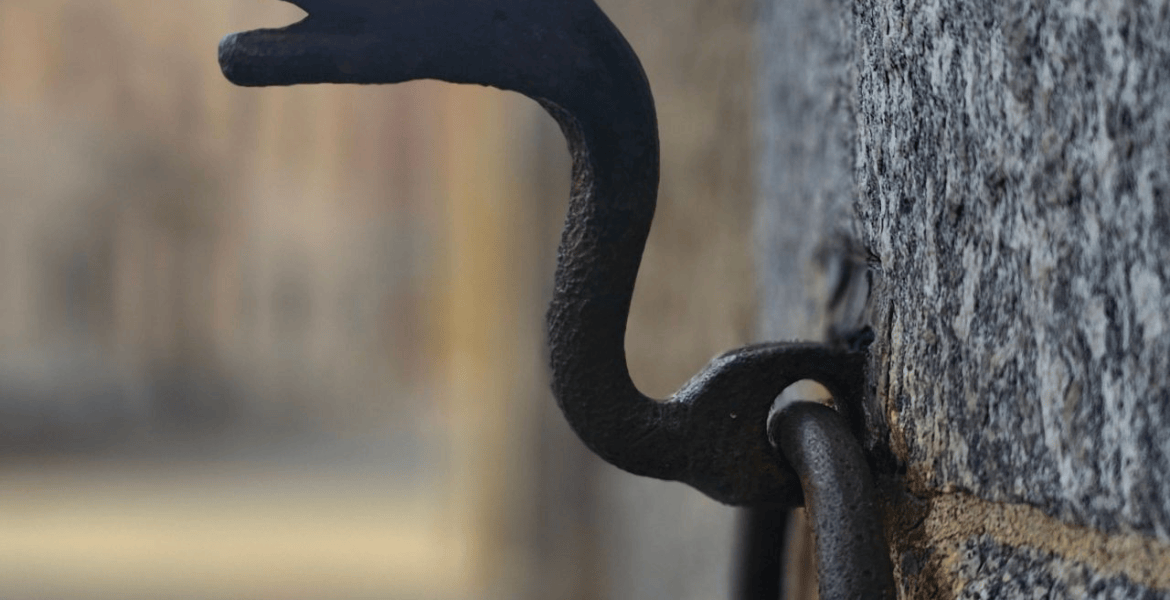
While exploring Monza, I noticed this unusual piece of ironwork on the stone wall of the Arengario, the medieval town hall in Piazza Roma, near the Duomo. Shaped like a serpent with an open mouth, it supports a heavy ring that was most likely used to tether horses.
Before motorized transport, rings like these were common outside public buildings, inns, and homes. People tied up their horses while visiting the market or attending to business. But this example has more character than a simple iron loop.
The Arengario dates to the late 13th century. An inscription records its construction in 1293, when Pietro Visconti was podestà of Monza. Its open ground-floor portico accommodated commerce, while the hall above served civic administration. Announcements were made from the small balcony known as the Parléra.
The serpent shape is especially intriguing in this setting. The Visconti biscione, a serpent often shown with a human figure in its mouth, became one of the family's most recognizable emblems. Given the Visconti association with the Arengario, the ironwork may echo that heraldic tradition. I haven't found evidence confirming its date or intended symbolism, so the connection remains a possibility, not a certainty.
Similar serpent-shaped tethering rings can also be seen on the Palazzo della Ragione in Piazza Mercanti, Milan.
This small discovery sparked my curiosity to learn more about the Visconti beyond Milan, and how their influence shaped other towns across Lombardy. It's a reminder of why I enjoy exploring historic places slowly: an easily overlooked detail can open up a much larger story.
Photo by C. Abernethy. Location: Arengario, Piazza Roma, Monza.
#Monza #Lombardy #Italy
Discover more from MilanoStyle.com
Subscribe to get the latest posts sent to your email.