

Searching for something spooky? Here is our guide to haunted places in Milan; from bone-filled chapels to haunted castles and ghostly opera houses, explore Milan’s most chilling legends and discover the eerie side of Italy’s fashion capital.
Halloween may not be an official holiday in Italy, but it’s finding its place in the calendar. Children dress up, pumpkins appear in shop windows, and themed parties fill the city’s nightlife. Yet, while October 31st is just for fun, November 1st—Ognissanti, All Saints’ Day—is a solemn national holiday, when Italians honor the departed. If there’s one city where the veil between past and present feels especially thin, it’s Milan.
Among the shining skyscrapers and elegant boutiques, old Milan hides a darker side—whispers of restless souls, condemned spirits, and echoes of tragedy that linger in the city’s cobblestoned streets and grand palazzi.
Here are some of Milan’s most haunted places, where history refuses to rest quietly.
The Devil’s Column
Piazza Sant’Ambrogio
Outside the Basilica di Sant’Ambrogio stands a single marble column, its surface marked by two deep holes. To the casual visitor, it’s just an ancient artifact. But the legend it carries is far more sinister.
Centuries ago, Saint Ambrose was said to have confronted the Devil himself on this very spot. The demon tried to tempt the saint, tormenting him with lies and mockery until Ambrose, enraged, struck him with a powerful kick. The Devil’s horns pierced the marble, trapping him there until he vanished—leaving behind the holes as evidence of his defeat.
Some say that if you lean close enough, you can still smell sulfur rising from the openings. Others claim that on certain nights, especially before Easter, a ghostly carriage drawn by black horses circles the piazza, carrying the souls of the damned straight back to Hell.
The (Unofficial) Monument to Witches
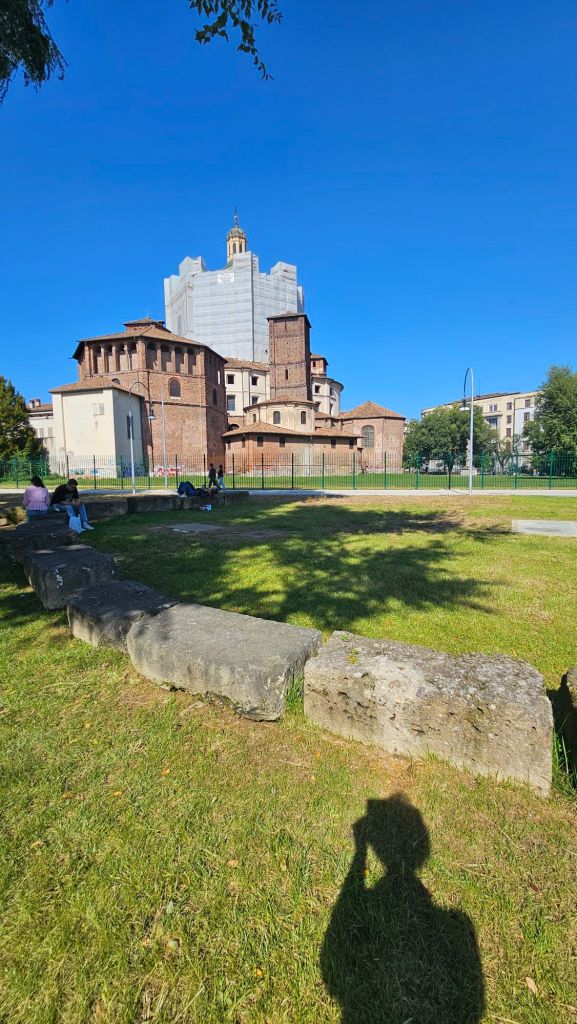
Piazza Vetra, near Basilica di San Lorenzo
This quiet park, shaded by trees and overlooked by church domes, once witnessed unspeakable horror. From the 14th to the 17th centuries, hundreds of women accused of witchcraft were tortured and burned at the stake here.
The unofficial Monumento alle Streghe, a semi-circle of stone slabs in the area between the church and the park, now marks the place where the condemned met their fate. The first were Pierina de Bugatis and Sibilla Zanni, executed in 1390 for allegedly worshiping pagan goddesses. Their cries echoed through the square, and for two hundred years, the executions continued—drawing crowds eager to watch the flames.
At night, locals say you can feel the chill of their presence. Flickering streetlights, strange breezes, and muffled whispers have been reported by passersby.
San Bernardino alle Ossa

Via Verziere
Tucked away behind the Basilica di Santo Stefano Maggiore lies one of Milan’s most macabre treasures: San Bernardino alle Ossa, a chapel where every wall is decorated with human bones. Skulls line the arches; femurs form intricate Baroque patterns around the altar.
The ossuary was created in the 13th century when the nearby cemetery overflowed, and bones were moved into this small chamber. But time turned necessity into art—grim, sacred, and strangely mesmerizing.
According to local lore, the ghost of a young girl appears here every year on the anniversary of her death. Visitors claim to have seen her kneeling before the altar, her pale face illuminated by candlelight before fading into the shadows.
Whether you believe in ghosts or not, the stillness inside San Bernardino alle Ossa feels heavy, as if the walls themselves are watching.
The Ghosts of Sforza Castle
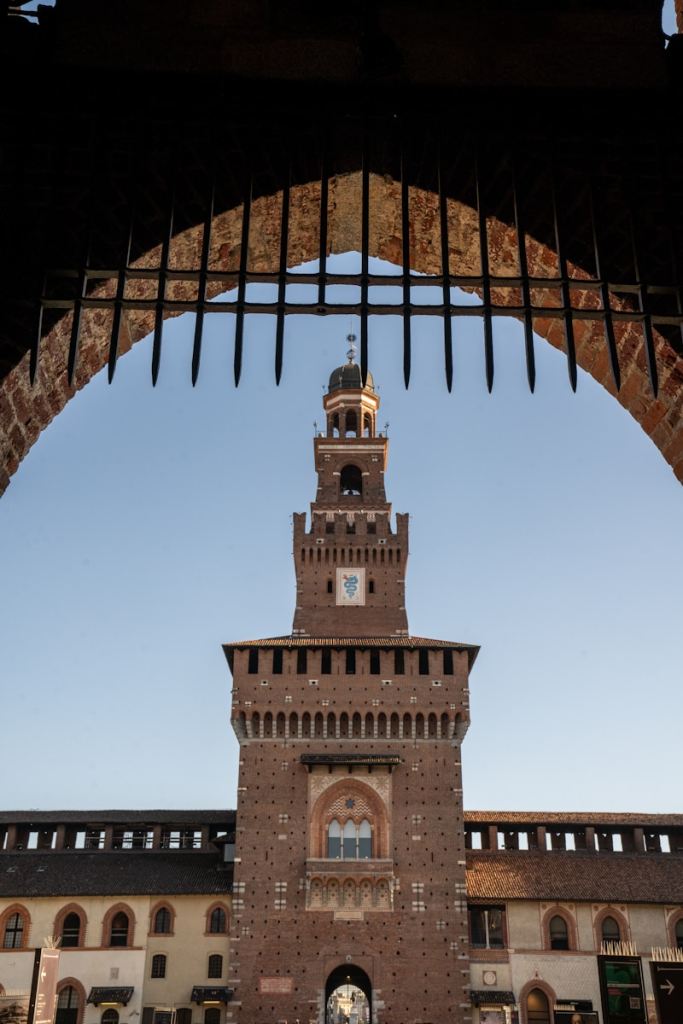
Piazza Castello
Few places in Milan hold more stories—or more spirits—than the Castello Sforzesco. Behind its red-brick walls, rulers plotted, artists painted, and prisoners vanished. Today, the castle hosts museums and concerts, but when the crowds leave, the corridors come alive with something else entirely.
The most famous of its phantoms is Ludovico il Moro, the Duke of Milan, who lost everything when the French invaded in 1499. He is said to appear clutching his treasure, fleeing endlessly through the halls, his footsteps echoing against the stone.
He’s not alone. The ghost of Beatrice d’Este, his beloved wife who died in childbirth, is heard crying for her child. Bona di Savoia, another duchess, wanders the upper galleries searching for her lost family, while Bianca Scappardone Visconti, executed by beheading, drifts silently through the courtyard, her spectral form faintly glowing in the moonlight.
Parco Sempione
Even the nearby Parco Sempione isn’t spared: the Dama Velata, the Veiled Lady, is said to roam its paths dressed in black, her face hidden beneath a veil. She reaches for the hands of those who dare to look at her—only to reveal a skull beneath her lace.
The Library of the Ambrosiana

Piazza Pio XI
Among priceless manuscripts and Renaissance artworks, one restless spirit continues her search for a lost love. Lucrezia Borgia, daughter of Pope Alexander VI, is said to haunt the Biblioteca Ambrosiana, where the letters she once exchanged with the scholar Pietro Bembo are kept.
In a sealed frame nearby rests a lock of her golden hair—said to tremble slightly whenever her ghost passes through the room. Librarians working late have reported hearing the faint rustle of skirts and the scent of rosewater lingering long after closing time.
Teatro alla Scala

Via Filodrammatici
The world’s most famous opera house is also one of Milan’s most haunted. Built in 1778, La Scala has seen triumphs, scandals, and heartbreak—but none so enduring as the spirit of Maria Callas.
The legendary soprano, who made Milan her home and her stage, is said to return to perform for eternity. Technicians working late have heard the echo of her voice during rehearsals or glimpsed a silhouette standing under the spotlight on an empty stage.
When the theater is silent and the air still, the faintest hum of Casta Diva drifts through the balconies—an encore from beyond.
A City of Shadows and Secrets
By day, Milan is a city of art, ambition, and style. But after dark, its history breathes again. From the eerie stillness of ossuaries to the ghosts of duchesses and divas, Milan’s haunted places remind us that beauty and darkness often share the same stage.
So this Halloween, skip the costumes and candles—and take a moonlit stroll through the city’s forgotten corners.
Just remember: in Milan, the past never truly sleeps.
You may also like:
Subscribe to our Free Newsletter
Subscribe to get the latest news, updates, and invitations.
Discover more from MilanoStyle.com
Subscribe to get the latest posts sent to your email.
